The complete guide to forward auctions: How they work, types, rules, and best practices

What is a forward auction? It is a selling process in which buyers compete for a seller’s asset or offering. This guide explains the mechanisms, rules and practical decisions behind an auction—from listing and qualification to bidding, closing and settlement.
Forward describes buyer competition for a seller’s offering; ascending bidding is one format, not the only format.
Clear reserves, increments, close rules and charges help participants make informed decisions.
Measure completed transactions and net proceeds, not only the highest bid.
What is a forward auction?
A forward auction is a selling process in which a seller offers an asset, product or right and interested buyers compete to purchase it. In the familiar ascending format, buyers submit progressively higher bids and the highest eligible bid wins, provided the reserve and other published sale conditions are satisfied.
The defining feature is the direction of competition: buyers compete for what the seller is offering. “Forward” does not mean that every auction must use rising, visible bids. Seller-side auctions can also use sealed bids or a descending-price mechanism. The format determines how bids are submitted, what participants can see and how the winner’s payment is calculated.
Forward auctions are used for property, vehicles, industrial equipment, collectibles, surplus stock and other assets where competitive demand can help discover a price. They can be operated by an individual seller, an auction house or a marketplace serving many sellers. Each lot still needs a clearly identified seller, sale terms and an accountable operator.
For a business, the objective should extend beyond the highest number on a screen. A successful auction converts qualified interest into a completed transaction, with acceptable net proceeds, a manageable selling timeline and a defensible record of the process.
How does a forward auction work?
A typical online forward auction moves through six connected stages. The exact sequence varies by asset and sale terms, but the operational work begins before bidding opens and continues after the clock stops.
1. Prepare the asset and sale information. Define the lot, ownership or sale authority, condition, location, inspection arrangements and documents buyers need. Decide whether related assets should be sold separately, as a package or through a multi-lot event. Publish the charges and obligations that affect the buyer’s total cost.
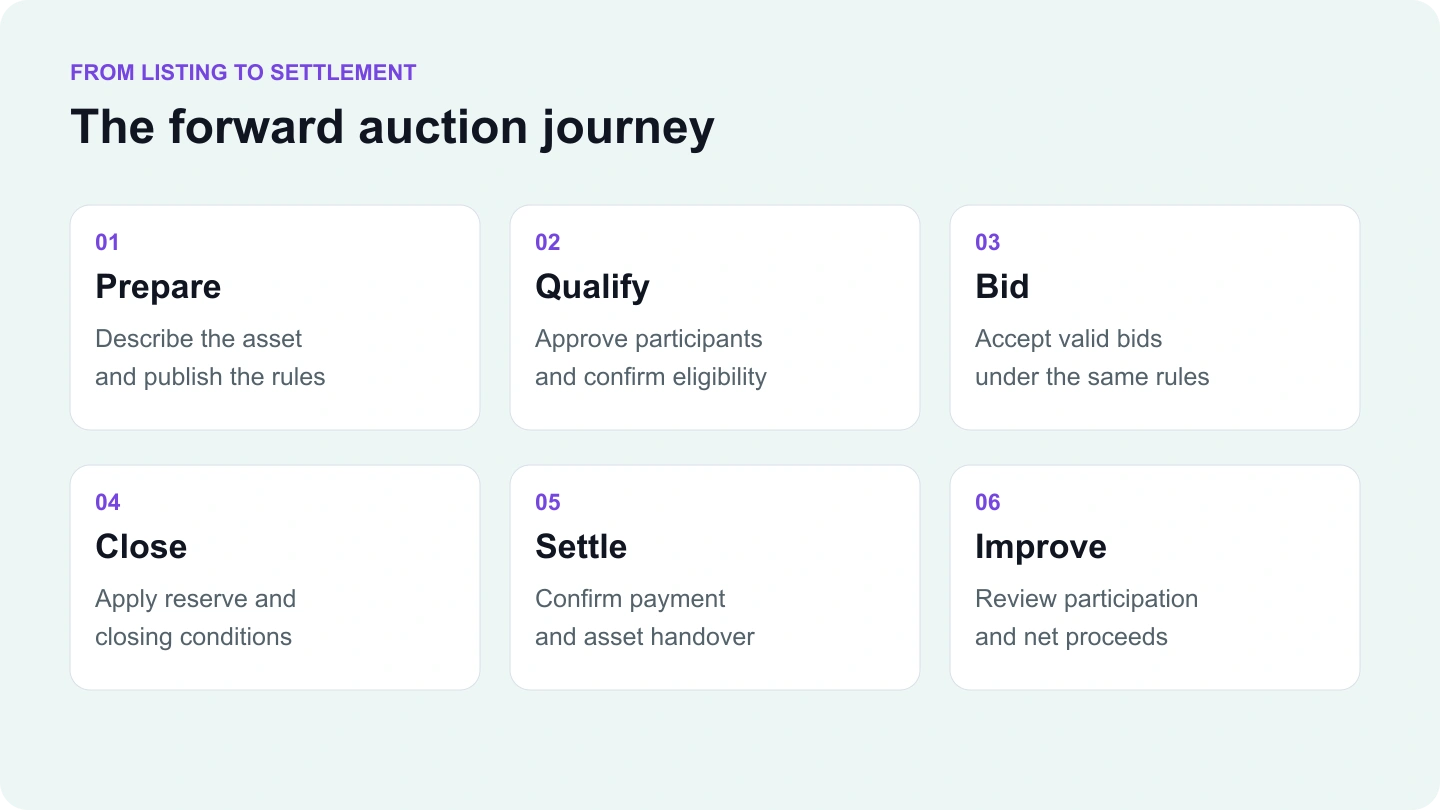 The auction process extends beyond bidding into qualification, settlement and review.
2. Configure the auction. Select the bidding mechanism, starting price, reserve policy, minimum increments and opening and closing times. Confirm the time zone, extension rules, bid visibility and any seller approval conditions. Test the configuration before inviting participants.
3. Register and qualify participants. Gather the information needed to establish eligibility. Depending on the sale, checks may include identity, company authority, financial capability or a deposit. Approval should happen early enough for qualified buyers to review the lot and practice the bidding workflow.
4. Run the bidding. Accept bids according to the published rules and provide reliable acknowledgements. In an ascending auction, the system identifies the leading valid bid and enforces the next allowable increment. Support teams should resolve access problems without privately changing the commercial rules for one bidder.
5. Close and determine the outcome. Apply the agreed closing mechanism, check the reserve and confirm any remaining approval conditions. Distinguish “highest bidder”, “provisional winner” and “completed sale” in communications. A notification should make the current status and required next action clear.
6. Complete and review the transaction. Issue the required sale documents, collect payment, reconcile charges and organize transfer or collection. Retain the event record, resolve exceptions and compare the outcome with the seller’s original objectives.
A forward auction example, step by step
Consider a fictional equipment auction with an $8,000 opening price, a $10,000 reserve and a $500 minimum increment. These numbers illustrate the mechanics; they are not pricing guidance or a prediction of auction performance.
The first buyer bids $8,000. Another buyer bids $8,500, and further accepted bids raise the price to $9,000, $9,500 and then $10,000. At that point, the reserve is met. A buyer offers $10,500 and another offers $11,000. If the auction closes with no further valid bid and all award conditions are satisfied, $11,000 is the winning bid.
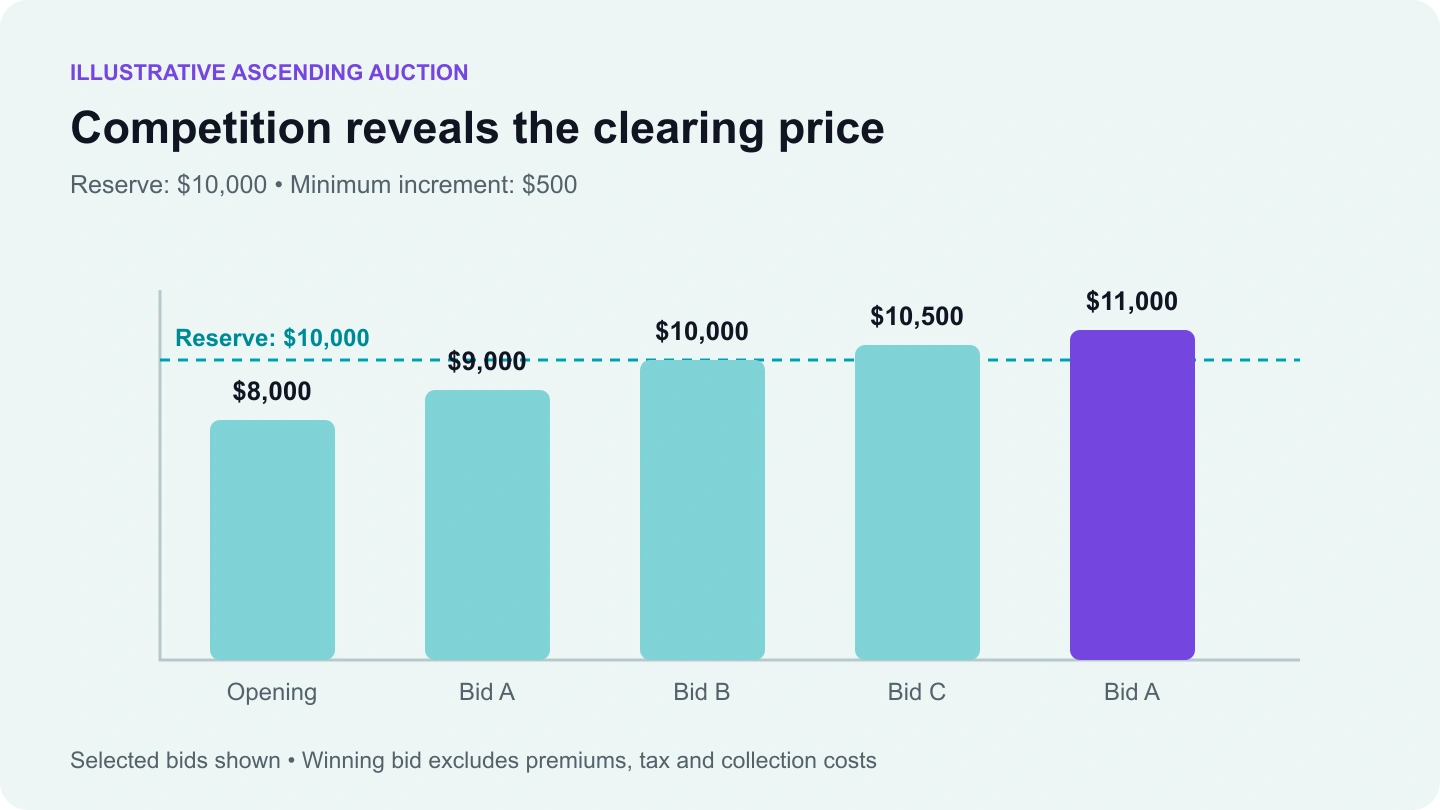 Illustrative ascending auction: selected bids are shown, with a $10,000 reserve and an $11,000 winning bid before charges.
The buyer’s invoice may exceed that figure. With a hypothetical 10% buyer premium, the premium would be $1,100 and the subtotal would be $12,100 before any applicable taxes, transport or other charges. The tax base and payment obligations depend on the actual terms and jurisdiction; the example deliberately excludes them.
If the highest bid had remained at $9,500, the reserve would not have been met. The lot’s next step would depend on the published conditions: it might remain unsold, await a permitted seller decision or be offered again. Reserve handling should never be invented after participants have committed their bids.
Forward auction vs reverse auction
A forward auction brings competing buyers to a seller’s offering. A reverse auction generally brings competing suppliers to a buyer’s requirement. In common ascending forward auctions, competition raises the bid. In common price-based reverse auctions, suppliers lower their offers to win the business.
That difference affects the entire workflow. A property seller needs asset disclosure, buyer qualification and transfer arrangements. A procurement team buying a defined service needs comparable specifications, supplier qualification and an award process that may consider more than price. Neither approach is suitable merely because a platform can display a live bidding screen.
| Question | Forward auction | Reverse auction |
|---|---|---|
| Who initiates the opportunity? | A seller offering an asset or right | A buyer seeking goods or services |
| Who competes? | Buyers or bidders | Suppliers or service providers |
| Typical price direction | Upward in an ascending format | Downward in a price-based format |
| Primary commercial aim | Discover a sale price and complete the sale | Obtain a suitable supply offer |
| Other conditions still matter | Reserve, eligibility and sale conditions | Quality, capability and award criteria |
Types of forward auctions
It helps to separate the bidding mechanism from the delivery channel. “English”, “Dutch” and “sealed bid” describe mechanisms. “Online”, “live” and “hybrid” describe how people participate. “Timed” describes scheduling. “Reserve” and “no reserve” describe sale conditions. An event can combine several of these characteristics.
English or ascending auction. Bidders compete by raising the price. The highest remaining eligible bid ordinarily determines the winner, subject to sale conditions. Visible bidding lets participants respond to competition, but the operator must specify increments, close rules and what bidder information is disclosed.
First-price sealed-bid auction. Participants submit confidential offers by a deadline. The highest eligible bidder normally wins and pays their own bid, subject to the stated award conditions. The important operational controls concern confidentiality, access before opening and a documented evaluation process.
Second-price sealed-bid auction. In the basic single-item Vickrey model, the highest bidder wins but pays the second-highest bid. It is a specific payment rule, not another name for every platform that supports automatic bidding. Real implementations must explain any reserve and tie-breaking rules separately.
Dutch or descending-price auction. The seller begins with a high asking price and reduces it until a buyer accepts, in the basic single-unit version. It is still a forward selling process because buyers compete for the seller’s offering. Multi-unit variants need additional allocation rules.
The Nobel Prize’s auction-theory background explain these core mechanisms. For an operator, the practical lesson is to choose the information and payment rules deliberately rather than treating all auctions as equivalent.
- Timed online: bidding runs within a published window, with either a fixed close or a disclosed extension mechanism.
- Live: an auctioneer or live event controls the sequence and closing decisions under the auction rules.
- Hybrid: remote and in-room participants join the same sale; bid ordering and communication latency need careful handling.
- Multi-lot: assets are offered as separate lots, often with staggered close times so bidders can manage several opportunities.
- Reserve or no reserve: the seller either applies a minimum acceptable price or offers the lot without that price protection, subject to the full published terms.
The rules every forward auction should explain
Rules create predictable participation. A bidder should be able to understand how to qualify, place a valid bid, know whether it was accepted and determine what happens at the close. Put the operational rules next to the lot information, not only in a document that is hard to find.
Starting price and reserve. The starting price is where bidding can begin; the reserve is the seller’s minimum acceptable sale price where one applies. They are not interchangeable. State whether reserve status is visible and what happens if the reserve is not met.
Increments and bid acceptance. Explain the smallest permitted increase, including any price bands. Define whether bids may jump above the minimum. The system should distinguish an attempted submission from an accepted bid, especially during heavy activity near closing.
Hard close and soft close. A hard close ends at a specified time. A soft close extends the event when a qualifying late bid arrives. For example, an operator might add two minutes when a valid bid arrives in the final two minutes. That is only an example: publish the trigger, extension duration, repetition rules and any maximum extension for the actual event.
Ties, errors and exceptional events. Describe tie resolution, mistaken-bid handling, permitted withdrawals, outage procedures and who may authorize changes. If a rule allows a pause or restart, explain how participants will be informed. Keep an audit record of the event and the reason for any intervention.
Award, payment and transfer. State when the outcome becomes final, whether seller approval is required, when payment is due and how the asset will be transferred or collected. Auction law, consumer rights, licensing and property-transfer requirements vary; the terms must be reviewed for the specific market rather than copied from a different asset class.
- Eligibility, identity checks, deposits and participant approval deadlines
- Currency, minimum bid, increments and any reserve conditions
- Visibility of bidder identities, bid history and maximum proxy bids
- Time zone, closing rule and treatment of simultaneous submissions
- Buyer premium, seller charges, taxes and payment methods
- Inspection rights, condition disclosures and documentation
- Default handling, collection deadlines and dispute procedures
How proxy bidding works
Proxy bidding lets a buyer enter the maximum they are prepared to bid. The system then competes on their behalf according to the increment and priority rules, without necessarily placing their full maximum as the current bid immediately.
For example, suppose the current accepted price is $10,000 and the minimum increment is $500. Buyer A sets a maximum of $12,000. If buyer B subsequently bids $10,500, the system may advance A to $11,000. If nobody bids again, A may win at $11,000 rather than paying their $12,000 maximum, provided the event’s reserve and other rules are satisfied.
Equal maxima, reserve prices, small differences between competing maxima and special increment rules can change that simplified example. Tell bidders exactly how the implementation behaves. eBay’s automatic bidding guide provides one real-world example of maximum bids and automatic increments; it is not a universal specification for every auction platform.
A proxy maximum is commercially sensitive information. Limit access to it, record administrative access where appropriate and explain the confidentiality policy. Staff should never use a participant’s private maximum to manufacture competition.
When should a business use a forward auction?
Forward auctions are most useful when there is a credible pool of buyers, the offering can be described well enough for comparison and the seller is prepared to follow a clear transaction process. Scarcity alone is not enough. Qualified demand and confidence in the information are what enable meaningful competition.
Asset owners can use auctions for equipment disposals, vehicle fleets, surplus inventory and property. Auction houses can organize specialist events around collectibles or a particular asset category. Marketplace operators can standardize participation and seller controls across repeated events.
The US General Services Administration’s methods of sales illustrate an important distinction: auctions are one selling method alongside alternatives such as fixed-price sales. Choosing an auction should be a commercial decision, not a default for every listing.
A negotiated sale may be more suitable when there is only one credible buyer, the transaction requires substantial bespoke negotiation, confidentiality prevents adequate disclosure or evaluation depends on complex non-price commitments. A fixed-price listing may suit standardized stock with an established price and a need for continuous purchasing.
- Use an auction when the seller can attract several genuinely interested and eligible buyers.
- Give buyers sufficient time and evidence to assess condition, transfer requirements and total cost.
- Confirm that the seller can complete the transaction if the published conditions are met.
- Compare expected net proceeds and selling effort with realistic alternative sale methods.
Best practices for sellers and auction operators
Build demand before opening bidding. Identify the likely buyer groups, promote the offering where they already look for assets and leave time for inspections and questions. Registration counts are not the same as active competition: monitor how many approved participants actually bid.
Make the lot information decision-ready. Use clear photographs, asset identifiers, condition reports and relevant documents. Describe material limitations as carefully as attractive features. If an answer to one buyer’s question affects everyone’s valuation, publish the clarification consistently.
Design lots around buyer demand. Large bundles can simplify administration but exclude buyers who only want part of the package. Splitting assets can widen participation but create collection and coordination costs. Consider buyer capability, asset dependencies and transfer constraints before deciding.
Set price controls with evidence. Use market information, asset condition and the seller’s acceptable outcome when setting the reserve. An ambitious reserve can protect against a low sale price but may also leave the asset unsold. A low opening bid can invite participation, yet cannot compensate for weak demand or incomplete information.
Test the difficult moments. Rehearse late bidding, equal proxy maxima, failed payments, lost connections and support escalations. For hybrid events, test bid ordering between online and in-room participants. Agree who can pause a sale and how the decision will be recorded.
Keep the close and settlement connected. Give the winning bidder a clear next step, identify a transaction owner and track completion deadlines. Reconcile deposits, fees and refunds. Treat unpaid awards and failed collection as operational outcomes to investigate, not merely administrative details.
Review the whole event. Compare participation, sale completion, net proceeds and effort with the plan. Record what changed and why, then improve one or two specific parts of the next auction. Avoid making major rule changes based on one unusual result.
Best practices for bidders
A good bidding plan starts with valuation and due diligence, not the excitement of the final minute. Decide what the asset is worth to you, identify the uncertainties and calculate the total amount you would need to spend after winning.
For equipment, that may include inspection, transport, installation and repair. For property, it may include professional advice, financing, transfer costs and conditions that require specialist review. For collectibles, authenticity, provenance and condition can dominate the decision. The relevant checks depend on the asset.
Read the terms before using a proxy bid. A maximum is a spending instruction to the platform, not simply an expression of interest. Stay within a limit you can fund and do not assume you can withdraw a bid whenever you change your mind.
- Complete registration and any deposit requirements before the deadline.
- Inspect the asset or review the available evidence; ask material questions early.
- Set a maximum all-in budget and a separate maximum bid.
- Check the time zone, extension rules and whether the auction uses a reserve.
- Confirm each bid is accepted rather than assuming a click or email guarantees acceptance.
- Keep payment and collection resources ready if you win.
- Do not coordinate bids with competitors or use additional accounts to simulate demand.
Common mistakes that weaken auction outcomes
The most visible mistake is optimizing for the highest bid while ignoring whether the transaction completes. A high provisional result means little if the bidder cannot pay, the asset description is disputed or collection arrangements fail.
Another mistake is relying on unclear terminology. “No reserve”, “subject to approval”, “winning bidder” and “sold” can imply different obligations. Use them consistently and explain the event’s conditions before bidding begins.
Poorly managed extensions can frustrate participants, but a fixed deadline is not automatically better. Choose the close mechanism for the audience and sale format, explain it clearly and test it. Similarly, adding more software features does not solve an absence of qualified buyers.
Finally, do not treat allegations of artificial bidding or conflicts of interest as ordinary customer-service tickets. Preserve the relevant records, apply the published investigation process and involve the appropriate accountable people. Trust is part of the auction’s commercial value.
| Mistake | Practical correction |
|---|---|
| Incomplete asset information | Publish consistent evidence and provide a clear question process |
| High reserve with no market evidence | Review comparable information and the cost of leaving the asset unsold |
| Too many lots closing together | Consider staggered closes and test multi-lot bidder journeys |
| Hidden charges | Show the buyer’s full charging structure before bidding |
| Manual, undocumented overrides | Use controlled permissions and retain reasons and timestamps |
| Ignoring settlement | Assign an owner and measure paid, completed transactions |
What to look for in forward auction software
Choose software against the operating process you intend to run. A compelling bidding interface is only one part of the system. The platform also needs to support configuration, evidence, participant management and the handoff into payment or settlement.
Ask providers to demonstrate a realistic event using your rules and an awkward exception. For example: a bidder reaches their proxy maximum during a soft close, an integration is briefly unavailable and the reserve is only just met. The demonstration should show what bidders see and what operators can audit.
For repeat operations, assess data ownership, export access, integration reliability, accessibility, support arrangements and recovery procedures. If AI is offered, ask what it actually assists with, how its outputs are checked and who remains accountable for decisions. Do not assume an AI label guarantees better prices or fairer outcomes.
- Configurable formats, reserves, increments and closing rules
- Lot catalogs, document access and consistent condition information
- Bidder registration, qualification, deposits and permissions
- Reliable bid acceptance, proxy bidding and participant notifications
- Timestamped event records and controlled administrative actions
- Payment, CRM, finance and asset-system integrations where required
- Reporting on participation, net proceeds, exceptions and completion
- Accessible mobile journeys, realistic load testing and recovery planning
How to measure forward auction performance
Use a small set of measures that explain the commercial and operational result. Keep definitions consistent between events; a “registered user” and an “approved bidder” should not be interchangeable in a report.
Track the proportion of offered lots that achieve an accepted sale, the proportion of awarded lots that become paid transactions, the time from close to completion and seller net proceeds after relevant selling costs. Review active bidders per lot alongside those measures so that pricing outcomes have participation context.
Useful diagnostic measures include inspection-to-registration conversion, approval delays, support requests, bid-rejection reasons and settlement exceptions. Compare like-for-like assets where possible. Changes in asset quality or market conditions can affect results even when the auction process has not changed.
For a starting assessment of the wider operation, use the auction maturity tool. To turn findings into a platform evaluation, use the auction software requirements checklist.
A practical pre-launch checklist
Before opening bidding, bring the commercial owner, auction operator and support team together for one final review. Test the participant journey on both desktop and mobile and confirm that the published information matches the platform settings.
- The seller’s authority and the asset description have been confirmed.
- Material documents, images and inspection arrangements are available.
- The reserve policy, increments and closing rules are approved and configured.
- Charges, payment conditions and transfer obligations are clearly stated.
- Participant qualification and any deposit workflow have been tested.
- Bidders know the time zone, support route and how to verify an accepted bid.
- Outage, incident and dispute responsibilities are assigned.
- The award notification and settlement workflow are ready.
- The team has agreed what evidence and performance measures to retain.
Build the auction around the transaction
Forward auctions connect buyers through a structured selling process. Their effectiveness depends on the interaction between demand, reliable information, clear rules and follow-through. The auction mechanism matters, but it cannot compensate for poorly described assets or an unworkable settlement process.
Start with the transaction you need to complete, choose a format that fits the asset and audience, and make the rules understandable before anyone bids. Then use the event record to improve the next sale.
Explore Bidvantic forward auction software to discuss how your catalogs, participants, auction rules and post-auction workflows can fit together.
RELATED QUESTIONS
Is a forward auction the same as an English auction?
No. English auctions use ascending bids and are a familiar forward auction format. Forward describes buyers competing for a seller’s offering; sealed-bid and descending-price formats can also be used for selling.
Does the highest bidder always win?
Not automatically. The bid must be valid and eligible, and any reserve or published approval conditions must be satisfied. The auction terms determine when the outcome becomes final.
What happens if the reserve is not met?
The lot may remain unsold or follow another outcome expressly allowed by the published terms. A seller should state the process before bidding opens rather than inventing an exception after the close.
What is the difference between a starting price and a reserve?
The starting price is the amount at which bidding can begin. A reserve is a minimum acceptable sale price where one applies. An auction can start below its reserve.
Does automatic bidding mean I pay my maximum?
Not necessarily. A proxy system may increase your current bid only as required to compete, up to your maximum. Reserve, tie and increment rules affect the actual price; check the platform’s stated behavior.
What is a soft close?
A soft close extends an auction when a qualifying bid arrives near the end. The trigger window, added time, repeat-extension rules and any limit should be published before bidding begins.
Can forward auctions be used for real estate?
Yes. Property auctions can use forward bidding, but disclosures, bidder qualification, deposits, contracts and transfer requirements must fit the property and jurisdiction. Specialist advice may be necessary.
What should a seller measure after an auction?
Look at active participation, accepted sales, paid completion, net proceeds, time to settlement and exceptions. A high bid alone does not establish that the event achieved its commercial objective.