
Real estate auction software
Real estate auction software built for modern property sales
Power property auctions with intelligent bidding, complete control and your brand at the forefront.
White-label | AI-enabled | API-connected | Enterprise-ready

Overview
AI-Powered Real Estate Auction Software
Real estate auction software connects property listings, approved participants and bidding in one digital experience. Give your team a clear view from auction preparation to the reviewed outcome.
Bidvantic brings AI guidance, property documents and auction operations together, helping buyers prepare and operators make informed decisions.
PrepareConnectReview
Prepare confidently
Bring property details, documents and auction rules together.
Engage bidders
Help approved buyers explore, understand and participate.
Control outcomes
Keep monitoring, award review and next steps in your hands.
Key features
Built for Every Stage of Your Property Auction
From property preparation to the final follow-up, bring your auction tools, people and intelligence into one connected platform.


Live bidding & auction experience
Bidder & seller management
Auction operations & reporting
Global reach & digital experience
AI-powered auction intelligence
Capabilities
Every Part of Your Auction. Intelligent.
From property preparation to live operations, give each team a clear place to work.
AI-powered auction intelligence
Give every decision more context
Bring property information and live auction signals into focus. Help buyers understand their position and operators see where attention is needed.
- Live Bid Advisor and private budget warnings
- Auction intelligence briefs
- Bidding momentum and engagement insights
- Auction health indicators for operators
Property & auction management
Move from property details to auction readiness
Give each property a structured home, then bring the catalogue, documents and event settings together before publication.
- Guided setup for single properties and multi-lot catalogues
- Photographs, documents and property categories
- Publication review and approval
- Reserve settings and auction scheduling


Live bidding & auction experience
Keep bidders connected to the moment
A clear bidding room helps approved buyers follow the price, understand the next increment and act within the auction’s published rules.
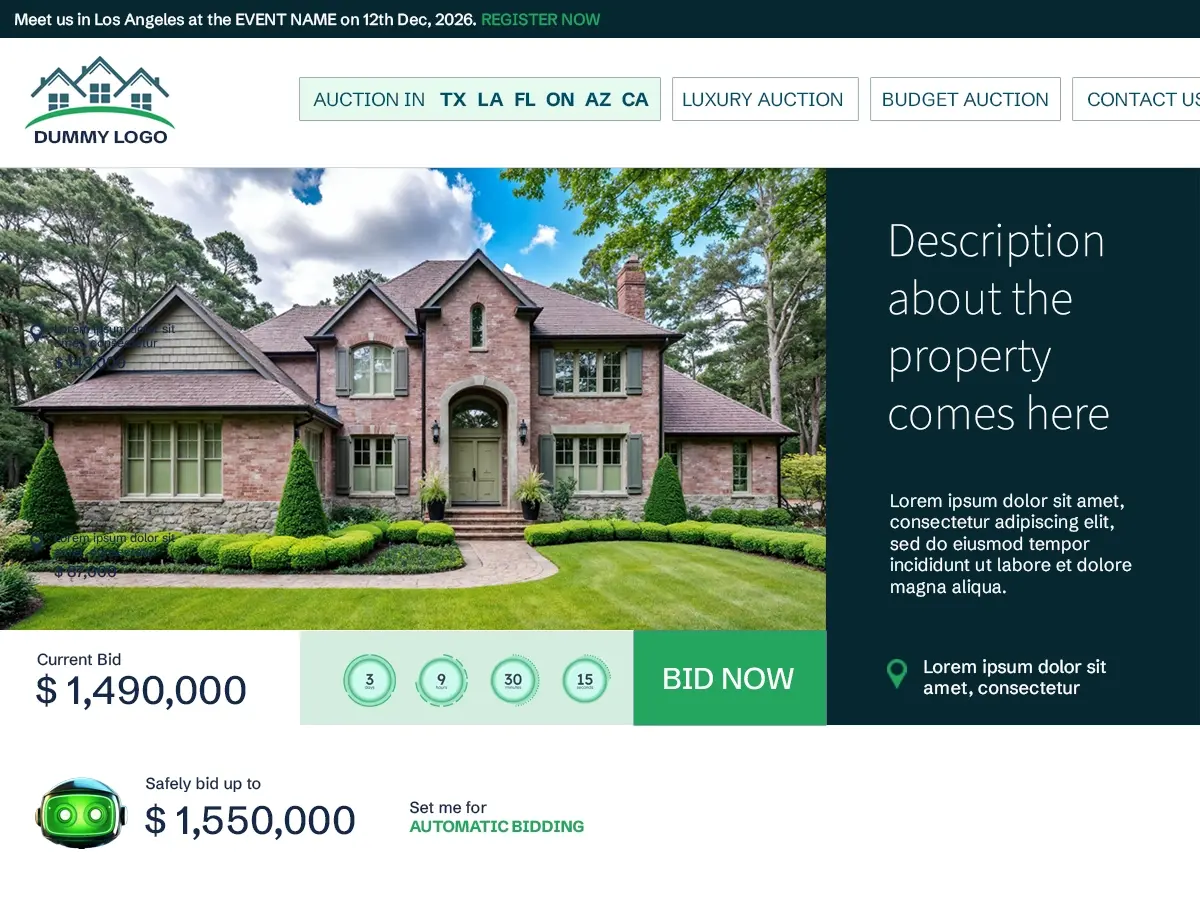
- Countdown, current bid and bidding increments
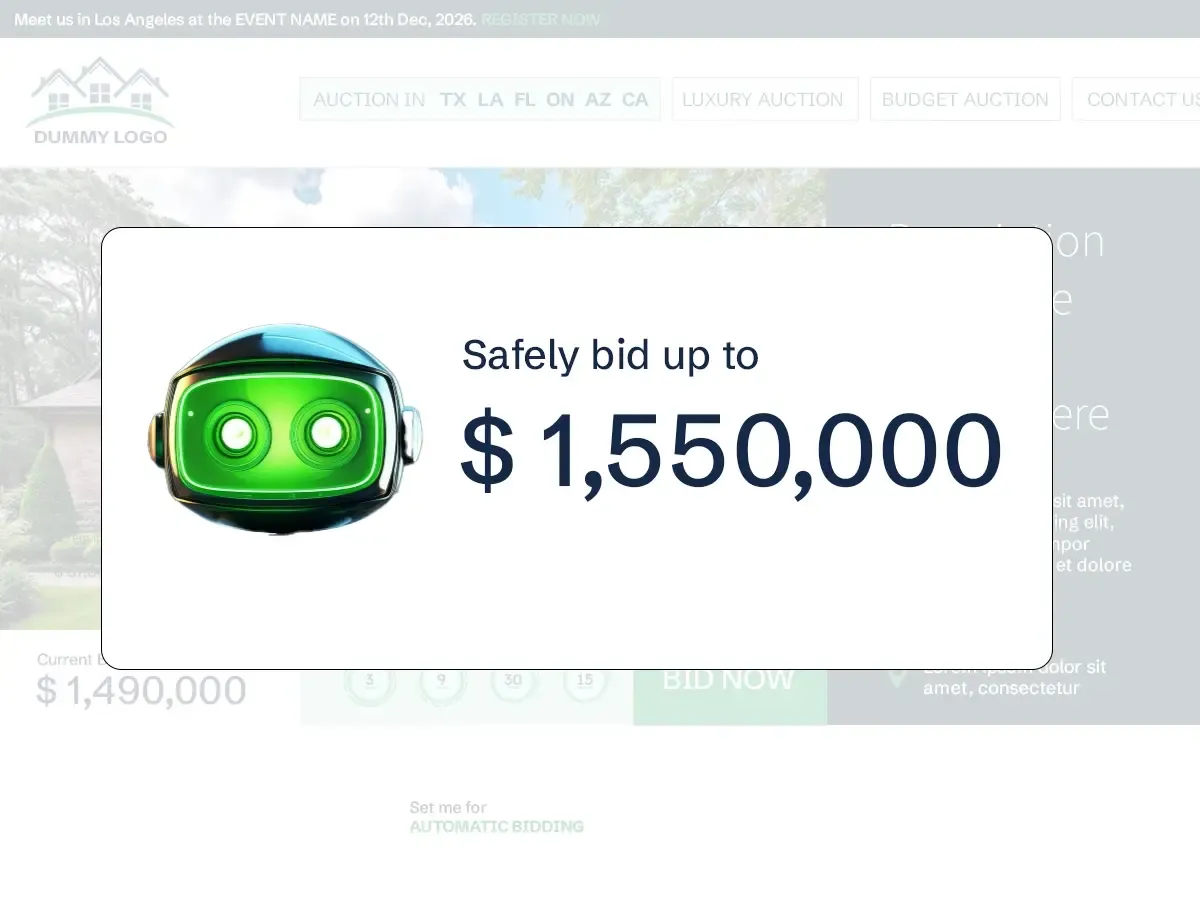
- Pre-bids and automatic bidding limits
- Configured closing extensions
- Accessible bid history
Bidder & seller management
Bring the right people into each auction
Connect seller workspaces with buyer profiles and participation review, so your team can manage interest from first enquiry to approval.
- Registration, identity review and participation approval
- Seller workspaces and buyer profiles
- Watchlists and property questions
- Notifications across the auction journey
Auction operations & reporting
See what needs attention. Keep the event moving.
Work from a central administration view to monitor activity, review outcomes and carry the right information into the next campaign.
- Central administration and live monitoring
- Low-activity and reserve-shortfall alerts
- Award review and unsold-property relisting
- Reporting exports for operational review
Global reach & digital experience
Make local property accessible from anywhere
Give remote buyers a clear path to property information and participation, with a digital experience configured for your audience.
- Mobile access and property browsing
- Supported language and currency configuration
- Search and social presentation
- Remote access to property information
Who we serve
One platform for every property auction model
From individual property sales to multi-property campaigns, connect your auction format, participant experience and operational controls in one platform built around real estate.
Real estate auction companies & auctioneers
Run branded property auctions with connected catalogues, bidder communication and live event oversight.
Online real estate auction platforms
Bring property discovery, registration and bidding into one digital destination under your own brand.
Foreclosure & REO companies
Coordinate property disposals with organized documentation, approved participants and recorded award decisions.
Banks & mortgage lenders
Bring property assets to market with controlled reserves, participation review and visibility across the disposal process.
Government agencies
Manage surplus land and property sales with publication approvals, clear participation rules and traceable records.
Real estate brokers, developers & investors
Organize individual properties or portfolio campaigns, connect sellers and buyers, and review activity across events.
Sales teams
Build buyer engagement, follow up interested participants and coordinate the next steps.
Marketing teams
Connect property content and enquiries with campaigns that bring buyers back.
Compliance & management
Standardize workflows, set role-based access and keep clear operational records.
Administration
Coordinate registrations, event settings, communications and record keeping.
AI auction intelligence
Intelligence Before, During, and After Every Auction
Turn property information and auction activity into clearer decisions. Give buyers practical guidance and your team the insight to prepare, monitor and improve every sale.
First-bid preparation
Start with a clearer pictureFirst-bid preparation, an auction intelligence brief and comparable property research help buyers approach each opportunity informed.
Property readiness
Surface what needs attentionDocument readiness, risk and information-gap alerts, and enquiry and content insights help teams address missing context.
Live bid guidance
Understand your next moveAI Bid Advisor, bid position and price-gap analysis, and private budget warnings put live bidding decisions in perspective.
Buyer & demand signals
See how interest developsBidding momentum, buyer engagement and property demand insights reveal how participants respond across your auctions.
Auction oversight
Focus on the signals that matterUnusual bidding pattern alerts, portfolio bid comparison and auction health indicators help operators prioritize their review.
Learning & follow-up
Make the next auction strongerFollow-up recommendations, role-based insights and post-auction performance learning turn auction activity into useful next steps.
For the buyer
Review property documents and set your private budget.
For the seller / operatorCheck documents and bidders before the auction opens.
Understand the property before the first bid.
For the buyer
Track your bid position and private budget warnings.
For the seller / operatorMonitor bidding activity and gaps against the reserve.
Put live competition in perspective.
For the buyer
Review your bids and confirm the next steps.
For the seller / operatorReview results to improve future property campaigns.
Turn the bidding history into a useful review.
ON DEMAND FEATURES
Build Around Your Property Process
Extend your platform with optional workflows for property visits, due diligence, participation and completion—configured around your team’s requirements.
Viewing & inspection bookings
Coordinate appointments and attendance with the property campaign.
Private due-diligence rooms
Control access to sensitive property information by participant and stage.
Legal-pack versioning
Track document updates and the acknowledgements your process requires.
Deposits & proof of funds
Add evidence review and eligibility steps before participation.
Representative & hybrid bidding
Define authority for representatives and assisted participation.
Portfolio / package bidding
Agree how grouped assets, package offers and award rules interact.
Document signing
Connect the reviewed award with the documents that require signatures.
Completion tracking
Follow post-award milestones alongside the legal and settlement teams.
Integrations
Connect the Systems Your Team Relies On
Carry property, participant and transaction information between your auction platform and the systems around it.
CRM & agency systems
- Reapit

- HubSpot

- Salesforce
- Microsoft Office 365


Property data & listing distribution
- Bridge Interactive
- Rightmove
- ATTOM

- PriceHubble



Maps & virtual tours
- Google Maps
- Esri ArcGIS

- Matterport


Identity verification
- Authenticator QR pairing
Eligible payments & deposits
- Stripe

- Razorpay

Electronic signatures
- DocuSign

- PEXA

- Simplifile

Accounting & communications
- Microsoft Office 365
- Salesforce
- Twilio

AI, content & workflow automation
- Supabase
- Google Gemini

- OpenAI

- Adobe PDF
- Sanity

- Calendly



Integrations are available on request, subject to provider access and an agreed scope. Provider names identify integration options, not partnerships.
Success Stories
 Germany
How a European asset recovery company launched its own multilingual, multi-currency online auction platform
Read case study United States
How a global photonics technology company built a secure, private forward auction platform with Bidvantic
Read case studyRole-based offerings
A Purpose-Built Workspace for Every Auction Participant
Give buyers, sellers and auction teams the tools, permissions and information they need throughout the property journey.

DESIGNED AROUND THE DECISIONS THIS ROLE MAKES
Buyers & bidders
Explore properties, prepare for participation and follow the auction with the information you need to make your next decision.
- Property search and categories
- Property details and documents
- Watchlists and property questions
- Registration and verification
- Participation approval status
- Live bidding and position tracking
- Pre-bids and automatic bidding
- Private budget warnings
- AI bid guidance and preparation
- Bid history and notifications
- Outcome and next-step updates
- Mobile auction access
Implementation & launch
Your Property Auction Platform. Implemented Your Way.
Choose the deployment approach that fits your business, with clear responsibilities and a practical path to your first auction.
THE APPROACH
Your infrastructure. Your control.
Run your property auction platform within your own technology environment, with hosting, access and data controls aligned to your organization.
- Deployment
- Your infrastructure
- Data control
- Organization managed
- Integrations
- Your approved systems
FROM FIRST CONVERSATION TO WHAT’S NEXT
4 clear stagesYour implementation journey
Discover
Map property types, auction rules, user roles and infrastructure requirements with your decision owners.
Requirements mappedConfigure
Set up catalogues, bidder approvals, reserves and the agreed property workflows.
Workflows configuredDeploy & validate
Prepare authorized data, connect scoped systems and test bidding, permissions and exception paths.
Environment validatedTrain & launch
Train buyers’ support teams and operators, confirm readiness and agree the support process.
Teams ready to operate
BUILT TO MOVE YOUR BUSINESS FORWARD
Let’s plan your implementationA governed auction platform, inside your own environment.
Explore a complete property auction journey
One property. A complete journey.
From Property Preparation to Auction Outcome
Follow Riverside House through an illustrative auction, with clear ownership at each stage.

Illustrative property
Riverside House
Lot 01 · Residential
STEP 01 / 06
Property record prepared
Create the Riverside House listing with photographs, property particulars and supporting documents. Review what buyers need to understand before registration.
Property details · Photographs · Supporting documents
1Prepare
2Configure
3Approve
4Bid
5Review
6Follow up
The right format for your property strategy
Confirm the format, visibility and award rules during setup.
Ascending
English auctionBidders raise the price in configured increments, with the leading bid visible under the event’s rules.
Descending
Dutch auctionThe asking price falls through defined steps until a buyer accepts, subject to the configured rules.
Sealed-bid
Confidential submissionsParticipants submit offers for an authorized opening and review, without a public price contest.
Silent
Private participationBuyers place private bids within a defined window, with visibility and review conditions agreed for the event.
Why Bidvantic
Confidence in Every Property Auction Decision
Give participants a clear process and your team the controls to oversee it.
From participation
to recorded decision.
Participation
Know who can take part
Registration review, bidder approvals and role-based access put participation decisions with your team.
Bidding
Make the event rules clear
Configure reserves, increments, visibility settings and closing extensions to fit the published auction conditions.
Oversight
Keep the outcome accountable
Use activity records, live monitoring, award review and recorded decisions to support a clear operational handoff.




The decision room
Questions worth answering before you choose an auction platform
Understand the workflows, controls and deployment options that fit your property auction business.
What is real estate auction software?
Real estate auction software is a digital platform used to manage property auctions from listing and bidder registration through competitive bidding and auction close. It typically includes property management, bidder qualification, auction configuration, real-time bidding, document management, payments, reporting and auction analytics.
How does real estate auction software work?
Real estate auction software brings the property, seller, bidders and auction rules into one digital environment. Auction teams publish property information, qualify bidders, configure reserves and bidding rules, conduct the auction, confirm winning bids and manage post-auction workflows through the platform.
What features should real estate auction software include?
Real estate auction software should include property and document management, bidder registration and verification, configurable auction formats, reserve management, real-time bidding, proxy bidding, bid extensions, notifications, payments, reporting, audit trails and integrations. Advanced platforms can also provide AI-driven bidder, property and auction intelligence.
What types of real estate can be sold through online auction software?
Online real estate auction software can support residential homes, apartments, commercial properties, land, development sites, foreclosure and distressed assets, institutional properties and multi-property portfolios. The platform can configure auction workflows around different property types and sale strategies.
What are the main types of online real estate auctions?
Common real estate auction formats include timed online auctions, live auctions, hybrid auctions and sealed-bid auctions. Multi-property auctions can also be used for portfolios or multiple lots, while configurable auction platforms allow bidding rules, reserves, increments and closing conditions to be tailored to each sale.
How does AI improve real estate auction software?
AI can analyze property information, bidder engagement and bidding activity to provide deeper auction intelligence. Applications include property data enrichment, bidder-interest analysis, auction-readiness insights, bidding-pattern analysis, performance intelligence and conversational access to auction data.
Can real estate auction software integrate with MLS, CRM and payment systems?
Yes. Modern real estate auction software can integrate with MLS/IDX property data, CRM platforms, payment gateways, escrow services, identity verification, e-signature, ERP, finance and analytics systems. API-based integrations allow auction data to move across the wider real estate technology ecosystem.
What should businesses consider when choosing real estate auction software?
Businesses should evaluate auction configurability, bidder management, property and portfolio capabilities, white-label options, commercial model, integrations, data ownership, reporting, governance, scalability and AI capabilities. The right platform should align with both current auction operations and future business models.
What is white-label real estate auction software?
White-label real estate auction software allows a business to operate property auctions under its own brand, domain and customer experience. It enables auction houses, property businesses and marketplace operators to maintain direct bidder relationships while creating a consistent branded auction environment.
Can real estate auction software manage multiple properties and portfolios?
Yes. Property auction management software can support individual assets, multi-property auction events and large real estate portfolios. Enterprise platforms can centralize property information, bidders, auction configurations, user roles and performance reporting across multiple auctions.
Which real estate auction software is suitable for auction houses and enterprises?
Auction houses and enterprises typically benefit from software that supports configurable auction formats, portfolio management, bidder qualification, white-label deployment, integrations, role-based controls, reporting and scalable auction operations. Bidvantic combines these capabilities with AI-driven auction intelligence, API-first architecture and a zero-commission model.
Book your property auction demo
Let’s talk property auctions
See Your Auction Business on Bidvantic
Bring your property mix, auction process and ambitions. We’ll walk through the platform and discuss what your team needs to launch with confidence.
Explore your auction workflow Confirm core and optional capabilities Discuss branding and rollout