Auction marketplace revenue models explained: How AI-powered online auction marketplaces make money

Auction marketplaces can combine transaction fees, recurring subscriptions, paid visibility, and value-added services. Start with a simple model that fits your buyers and sellers, then introduce additional revenue streams as participation grows. AI can support monetization by improving discovery, listing quality, and operational efficiency.
Overview
Every online auction marketplace makes money the same basic way: it captures a share of the value it creates when buyers and sellers compete. What separates the most valuable marketplaces is how many ways they capture that value, and how well they grow it with every auction.
This guide breaks down auction marketplace revenue models into four families: transaction, recurring, visibility and value-added revenue. It shows which models suit which marketplace, how to introduce them as you grow, and how AI is becoming one of the strongest revenue levers an operator has. AI makes bidders more confident, auctions more competitive and marketplace data more valuable.
It's written for founders, operators, enterprises and procurement leaders designing or refining the business model of an auction marketplace.
How online auction marketplace revenue works
At its simplest, an auction marketplace's revenue comes from three sources:
- Transaction revenue: Gross Merchandise Value (GMV) multiplied by your take rate, meaning the share of each sale you earn through commissions, premiums and fees
- Recurring revenue: Memberships and subscriptions that pay regardless of how many auctions close this month
- Service revenue: Visibility, payments, logistics, financing and data products layered on top of each sale
The world's largest auction operators show how powerful the mix can be:
- eBay reported a 13.94% take rate on USD 79.6 billion of GMV in 2025, with revenue growth driven partly by higher advertising penetration, proof that visibility revenue scales alongside transactions.
- RB Global earned USD 3.5 billion in service revenue on USD 16.2 billion of gross transaction value in 2025, a 21.6% service take rate that rose during the year on a higher buyer fee structure.
- Auction Technology Group lifted its take rate from 4.5% to 4.8% on USD 3.3 billion of GMV in its 2025 financial year, by extending value-added services, even while GMV held steady.
AI is already part of the story. On its 2025 results call, eBay reported that its AI-native listing tool lifted new listing creation by more than 50%, a direct boost to the supply every revenue model depends on.
The lesson for any operator: growth comes from both more auctions and more value captured per auction. AI now drives both.
A simple illustration: A marketplace with USD 10 million in annual GMV and a 10% blended take rate earns USD 1 million in transaction revenue. Raising average bids per lot through better bidder confidence lifts GMV, and adding memberships or featured listings lifts revenue per auction, so both parts of the equation grow at once. (Illustrative figures only.)
Revenue family 1: Transaction revenue
Transaction revenue is the foundation of most auction business models, because it grows directly with marketplace activity.
Seller commission. The marketplace earns a percentage of each final sale price. It's easy for sellers to understand, and they only pay when they sell. It suits asset owners, remarketers and multi-seller marketplaces.
Buyer's premium. A percentage is added to the winning bid and paid by the buyer, so the seller receives the full hammer price. For example, a USD 50,000 winning bid with a 10% buyer's premium means the buyer pays USD 55,000 and the marketplace earns USD 5,000 (illustrative). It's widely used in art, collectibles, industrial equipment and government surplus auctions.
Listing fees. A fixed or tiered fee to list a lot or run an auction event. It creates revenue whether or not a lot sells, and it discourages low-quality listings. It suits high-volume equipment, vehicle and liquidation marketplaces.
Payment and settlement fees. Integrated payments, deposits and escrow create a fee stream on the transaction infrastructure itself, alongside a smoother checkout for participants.
Where AI lifts transaction revenue
Every percentage-based fee grows when final prices and sell-through rates grow, and AI improves both. When bidders get a clear AI summary of each lot's details, documents and terms, they bid sooner and with more conviction. Real-time guidance on bid position and the next valid bid keeps them in the auction longer. Market pricing context helps sellers set realistic reserves, so fewer lots go unsold. More confident bidding means more bids per lot, stronger hammer prices and higher commission and premium revenue from the same inventory.
Revenue family 2: Recurring revenue
Recurring revenue smooths out the natural ups and downs of auction volume and builds long-term customer value.
Memberships for buyers. Frequent bidders, dealers and investors pay for early access to new lots, exclusive auctions, lower premiums or priority alerts.
Memberships for sellers. High-volume sellers pay a monthly or annual fee for bulk-listing tools, reduced commissions, storefront branding and performance reporting.
Enterprise access plans. Procurement teams and corporate buyers pay for multi-user access, approval workflows, integrations and dedicated support.
Where AI lifts recurring revenue
AI gives membership tiers something genuinely worth paying for. A premium tier can include deeper AI insight into each lot, richer market pricing context and personalized alerts when lots matching a member's interests go live. When members see that AI helps them find better lots and bid smarter, renewals follow, and recurring revenue becomes the most predictable line in your business.
Revenue family 3: Visibility revenue
As traffic grows, attention becomes valuable inventory in its own right.
Featured listings. Sellers pay to place lots on the homepage, at the top of categories or in email digests.
Sponsored events and categories. Brands or major sellers sponsor a themed auction event or an entire category.
Advertising and partnerships. Complementary businesses, such as logistics firms, inspectors, insurers and financing partners, pay to reach high-intent buyers at the moment of purchase.
Where AI lifts visibility revenue
Paid visibility is only worth what it delivers. AI-driven auction data shows which categories, price bands and lot types attract the most bidding, so operators can price featured placements by real demand and show sellers measurable results. Better results justify higher placement fees and bring sellers back to buy them again.
Revenue family 4: Value-added and data revenue
The highest-margin revenue often sits around the auction rather than inside it.
Transaction services. Inspections, authentication, logistics, insurance and financing turn a single sale into several revenue events.
Managed auction services. Marketplace teams run auctions on behalf of sellers who want results without the work, for a higher fee.
Partner marketplaces. Operators launch branded sub-marketplaces for industry partners, associations or large sellers, and earn a share of the activity they generate.
Data and intelligence products. Pricing benchmarks, demand trends and category reports for investors, procurement teams and sellers.
Where AI lifts data revenue
This is where AI creates the biggest step change. Every AI-assisted auction produces structured, comparable data: what sold, for how much, against which market references, with how much competition. Over time, that becomes a proprietary dataset no competitor can copy. Packaged into benchmarks, valuation context or category intelligence, it turns your marketplace from a place where deals happen into the source the market relies on to price them.
Which revenue models fit which online auction marketplace?
The right mix depends on how often participants transact, who holds the buying power and how much each sale is worth.
Marketplace type | Lead revenue models | Supporting models | Biggest AI revenue lever |
|---|---|---|---|
Vehicle and fleet remarketing | Buyer's premium, seller commission | Inspections, logistics, dealer memberships | Pricing context that lifts sell-through |
Industrial equipment and surplus | Seller commission, listing fees | Featured listings, financing, transport | AI lot summaries that bring remote buyers in with confidence |
Art, collectibles and luxury | Buyer's premium | Authentication, sponsored events | Comparable references that support high-value bids |
Procurement and reverse auctions | Enterprise access plans | Managed sourcing events, analytics | Supplier guidance that keeps competition active to the end |
Real estate | Buyer's premium, listing fees | Due-diligence services | Clear AI summaries of documents and terms |
Government surplus | Buyer's premium | Featured events | Transparent guidance that builds public trust |
Multi-seller B2B marketplaces | Hybrid commission and memberships | Featured listings, payments, data products | Demand data that powers premium tiers |
The auction marketplace monetization roadmap: when to add each revenue model
The best auction marketplaces don't switch on every fee at launch. They add revenue models in step with liquidity, so each new fee arrives when participants already see clear value.
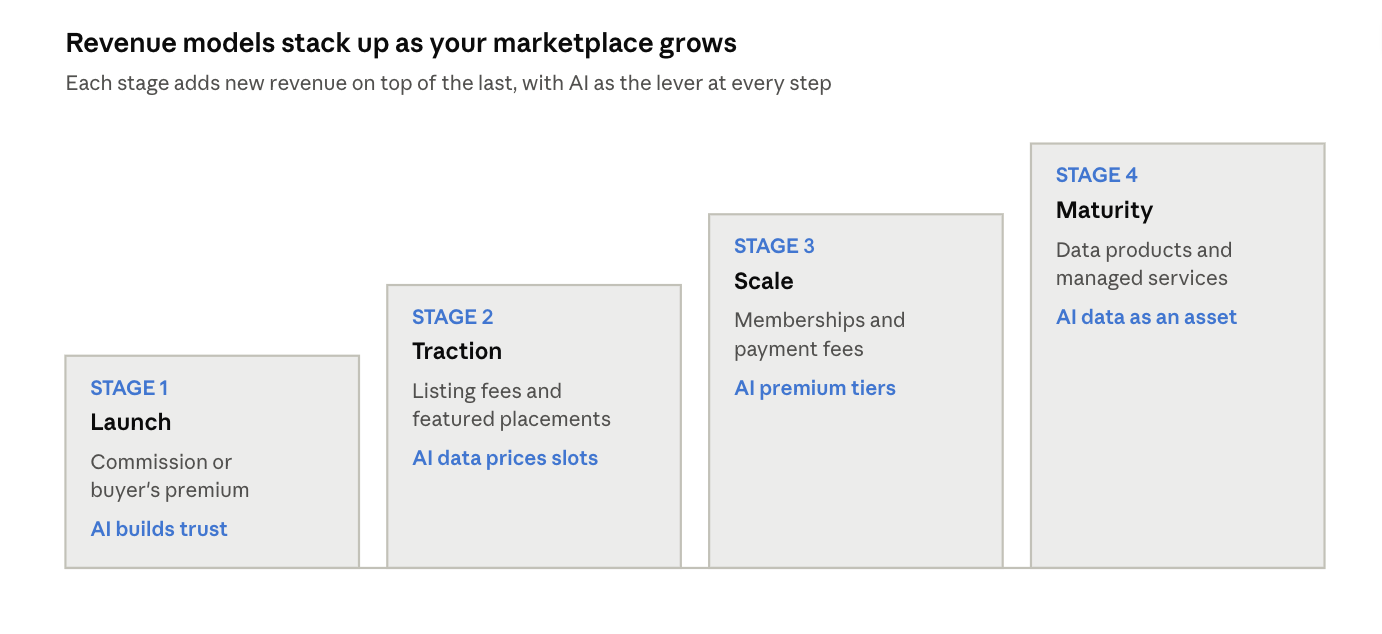
- Launch: earn on success.
Start with one simple transaction fee, such as a seller commission or buyer's premium, and keep listing costs low or free. AI lot summaries and bid guidance help first-time participants trust the marketplace and come back. - Traction: monetize attention.
Once bidding is active, introduce listing fees for premium slots and featured placements. Auction data shows which placements deliver results, so you can price them with confidence. - Scale: add recurring revenue.
Launch buyer and seller memberships, enterprise plans and integrated payment fees. AI-enhanced premium tiers give members a clear reason to subscribe. - Maturity: sell intelligence.
Package your growing dataset into benchmarks and category insight, and add managed services and partner marketplaces. Years of AI-assisted auctions become your most defensible asset.
Pricing principles that grow participation
- Keep it simple. One headline fee that participants can explain to a colleague beats a long schedule of small charges.
- Charge when value is delivered. Success-based fees build early trust, and upfront fees work best once results are proven.
- Show the full price. Display premiums and fees clearly before anyone bids, so winners never feel surprised at checkout.
- Reward loyalty. Lower fees for frequent sellers and members turn occasional users into regulars.
- Price by segment. Standard lots, premium lots and enterprise sourcing can carry different fee structures on the same platform.
- Let data guide changes. Review sell-through, bids per lot and repeat participation before and after every pricing change.
How Bidvantic turns AI into marketplace revenue
Bidvantic is an AI-powered, white-label auction platform built to help operators earn more from every auction, while keeping every dollar of that revenue in their own business.
Your revenue, your rules, zero commission
You choose how your marketplace earns. Commissions, buyer's premiums, seller fees, listing fees and service fees can all be configured around your strategy, by category, seller or auction type. Bidvantic takes no commission on your sales, so the fees your participants pay are yours to keep. Your marketplace charges commissions, and your platform doesn't take a cut of them.
Three revenue levers Bidvantic's AI is built to move
Every fee in your revenue model is a percentage of something: bids placed, prices achieved, lots sold. Bidvantic's AI auction software is aimed at exactly those three numbers.
Lever 1: Turn registrations into bids.
Registered users who watch but never bid generate no revenue. Auction Intelligence condenses each lot's specifications, documents and terms into one brief, removing the uncertainty that keeps people on the sidelines. More active bidders mean more GMV for every commission and premium to apply to.
Lever 2: Keep competition alive to the close.
The final minutes set the hammer price. Live Bid Advisor tells each bidder where they stand and what the next valid bid is, and privately flags when they are near their own limit, so they stay in the auction confidently instead of dropping out unsure. Stronger closing prices lift every percentage-based fee.
Lever 3: Set reserves that sell.
An unsold lot earns nothing. Market Pulse places each auction alongside comparable auction references, helping sellers choose reserves the market will meet. Higher sell-through turns the same inventory into more completed sales and more fee revenue.
As a byproduct, every AI-assisted auction produces structured, comparable data, the raw material for the premium tiers and intelligence products described above.
Configure your revenue model, not your code
- Commissions, buyer's premiums, seller fees and service fees configured by category, seller or listing type
- Featured placements and sponsored events switched on as traction builds
- Membership programs scoped around your model during implementation
- Integrated payments and settlement, the foundation for payment and escrow fees
- One platform for forward auctions, reverse auctions and multi-seller marketplaces, so new revenue lines don't need new systems
Comparing platforms? Our white-label auction software guide shows what to look for.
Still planning your marketplace? Start with how to start an online auction business.
Final thoughts
The most valuable auction marketplaces are built on more than transaction volume. They combine success-based fees, recurring memberships, paid visibility and intelligence products, introduced in step with growth. AI is now the force that connects them all, making every auction more competitive and every dataset more valuable. Design your revenue model around that, and each auction you run becomes worth more than the last.
RELATED QUESTIONS
What is an online auction marketplace?
An online auction marketplace is a digital platform where many sellers list items and buyers compete through bidding. The operator earns revenue from the activity it hosts, through fees, memberships and services.
How do auction marketplaces make money?
Most combine transaction fees, such as seller commissions, buyer's premiums and listing fees, with recurring memberships, paid visibility and value-added services like payments, logistics and data products.
What is a buyer's premium?
It's a percentage added to the winning bid and paid by the buyer, on top of the hammer price. The seller receives the full winning bid, and the marketplace earns the premium.
What is the best revenue model for an online auction marketplace?
There's no single best model. Most successful marketplaces start with one simple transaction fee, then add featured listings, memberships and services as participation grows.
What is a take rate?
It's the share of gross merchandise value a marketplace earns as revenue, combining all its commissions, premiums and fees.
How does AI increase auction marketplace revenue?
AI helps bidders understand lots, stay engaged as competition builds and compare prices with the market. That leads to more bids per lot, stronger final prices and higher sell-through. AI-assisted auctions also build valuable data that can support premium memberships and intelligence products.
If Bidvantic is commission-free, can I still charge commissions?
Yes. You can charge your participants commissions, premiums and fees in any combination. Bidvantic simply doesn't take a share of your sales.