Online auction business launch checklist: Everything to have ready before your first auction

A successful auction launch requires eight areas of readiness, each with a named owner: commercial, legal, platform, AI, inventory, bidders, operations, and testing. Run a full rehearsal before making the go/no-go decision, then track bidder activation and auction outcomes after launch.
Overview
You've chosen your market, your auction model, and your platform. Now comes the part that decides whether your first auction feels effortless or chaotic: being truly ready to launch.
This online auction business launch checklist covers everything that should be in place before you go live, organized into eight readiness areas. Each area has a clear owner and a practical checklist. The guide closes with a pre-launch test script, a go/no-go review, and the metrics to watch once your marketplace is live. It works for an auction house moving online, a procurement team running its first reverse auctions, an enterprise launching asset sales, or a founder opening a new marketplace.
Still shaping your strategy? Start with our guide on how to start an online auction business, then use this checklist to get launch-ready.
What makes this checklist different:
- An owner for every area, so nothing falls between teams
- AI readiness as its own area, not an afterthought
- A pre-launch test script that recreates real auction pressure before your bidders do
- Go/no-go criteria that make the launch decision objective
- The post-launch metrics that show whether your marketplace is gaining momentum
The launch readiness map
Launch readiness spans eight areas, and each one needs a single accountable owner. Assign them early, and review progress together every week until go-live.
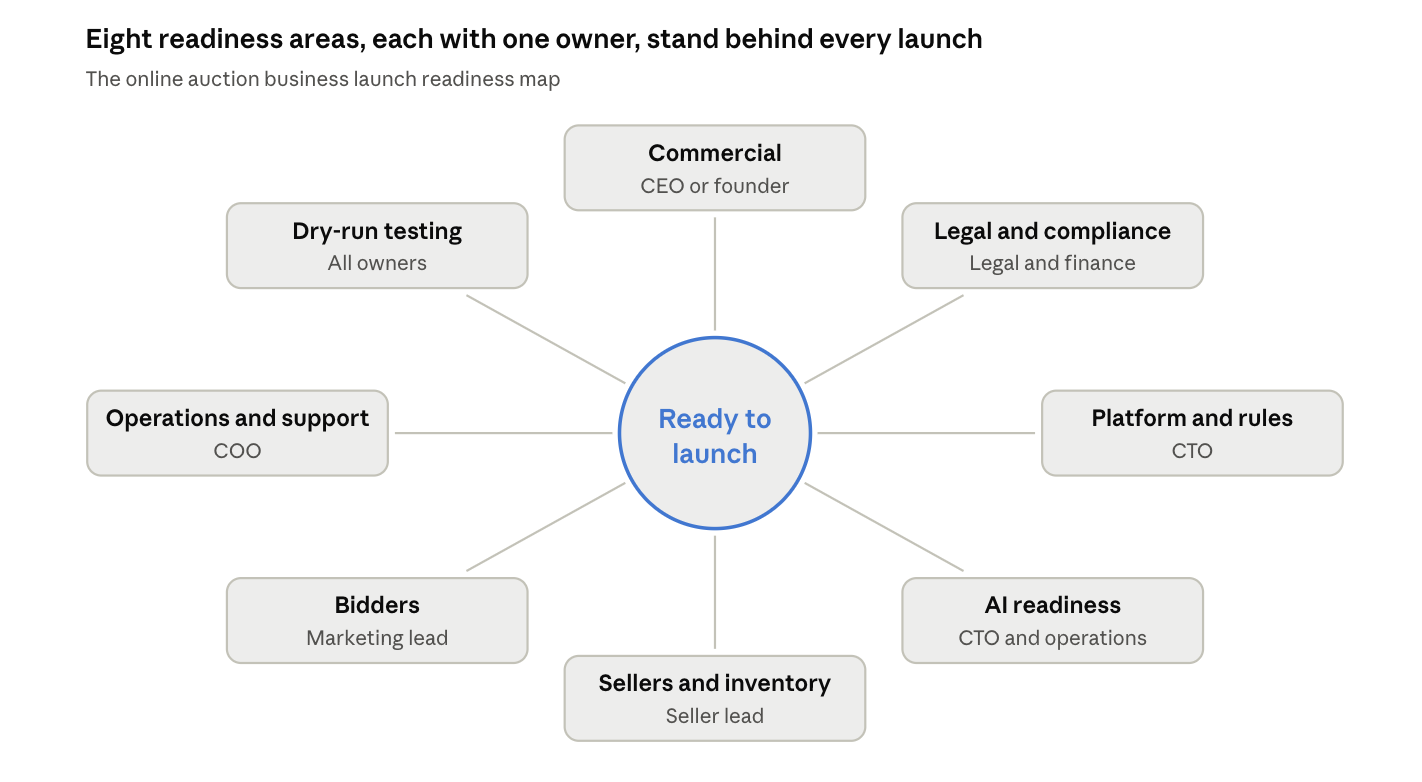
1. Commercial readiness
Owner: CEO or founder
- Launch scope confirmed: which auction models (forward, reverse, or marketplace), categories, and regions go live first
- Fee model set, such as buyer's premium, seller commission, listing fees, or memberships, and written in plain language
- Launch targets agreed: number of sellers, lots in the first auction and verified bidders
- Success metrics defined, so everyone knows what a good first auction looks like
2. Legal and compliance readiness
Owner: Legal and finance
- Business registrations, licensing and tax obligations confirmed for every launch market
- Terms of use, auction rules, seller and bidder agreements, and privacy policy published
- Fee schedule and payment, refund, and dispute policies published
- Card payments processed to PCI DSS security standards
- Industry-specific requirements reviewed, such as public procurement rules or regulated asset categories
3. Platform and auction-rule readiness
Owner: CTO
- Bid increments set for each price band, so bidding stays brisk on low lots and meaningful on high ones
- Soft close turned on, so a late bid extends the auction and the final price reflects real competition
- Reserve visibility, starting bids, and buy-now options decided by category
- Approval rules configured for listings, bidders, and winning bids where governance requires them
- Brand, domain, email sender, and mobile experience applied
- Payments, deposits, seller payouts, identity verification, and CRM or ERP integrations connected
Still comparing platforms? Our white-label auction software guide covers what to check.
4. AI readiness
Owner: CTO, with the auction operations lead
- Lot details, documents, and terms that feed each AI summary chosen, so bidders get clear context from the first auction
- AI visibility rules set for each auction format, so confidential information such as reserves or sealed bids stays protected
- Market references for AI pricing context selected for each category
- AI guidance tested from a first-time bidder's point of view
- Internal teams briefed on what AI shows bidders, so support can answer questions about it
5. Seller and inventory readiness
Owner: Seller or inventory lead
- Written commitments secured from launch sellers or asset owners
- Every launch seller onboarded and verified, with payout details confirmed
- Lots loaded with complete photos, descriptions, documents, and reserves
- Lot mix planned, balancing headline items that draw attention with steady sellers that keep bidding active
- Every listing reviewed against your quality standards
6. Bidder readiness
Owner: Marketing lead
- Pre-registration open, with bidders verified early so approvals don't slow launch day
- Launch campaign running through email, LinkedIn, industry partners and associations
- A short "how bidding works" guide and the auction schedule sent to every registered bidder
- Verified bidder numbers on track against the launch target
7. Operations and support readiness
Owner: COO
- Workflows mapped for listing approval, bidder approval, auction close, invoicing and settlement
- Support inbox, help center and response-time targets set up
- Support and auction managers trained on the platform, policies and escalation paths
- Saved replies prepared for the questions first-time bidders ask most
- A launch-day team named to monitor bidding, site performance and support in real time
8. Pre-launch testing: the dry-run script
Owner: CTO, with every area owner taking part
Run a full rehearsal auction with staff and friendly users playing buyers and sellers. Test the moments that matter most to real bidders:
- The closing minutes: many bidders bid at once, and soft close extends the auction correctly
- Outbid alerts: every bidder is notified instantly by email and on mobile
- Reserve not met: the lot closes correctly, and the seller is notified
- Failed payment: the winner is reminded, and the second-chance or relisting process works
- Refund and dispute: support resolves a test case from start to finish
- AI guidance: summaries show the right details, and nothing confidential appears in sealed or restricted auctions
- Mobile journey: a first-time bidder can register, bid, and pay on a phone without help
- Settlement: invoices, payouts, and reports reconcile correctly after close
The go/no-go review
Shortly before launch, bring every area owner together for a final review. Each criterion needs a clear yes. If any area falls short, fix it or narrow the launch scope, for example to fewer categories, rather than pushing ahead.
Area | Ready to launch when… | Owner |
|---|---|---|
Commercial | Scope, fees, launch targets and success metrics are confirmed | CEO or founder |
Legal and compliance | Terms, auction rules, privacy policy and fee schedule are published | Legal and finance |
Platform | Rules, branding and integrations are live, with no critical issues open | CTO |
AI | Summaries and pricing context are accurate, and visibility rules are confirmed | CTO |
Sellers and inventory | All launch lots are live in preview, with complete listings and reserves | Seller lead |
Bidders | Verified bidders meet the launch target | Marketing lead |
Operations | Support is staffed and trained, with escalation paths in place | COO |
Testing | Every dry-run scenario has passed | CTO |
Launch-day essentials
- A final check of lots, schedules and payment settings, followed by a reminder to registered bidders
- A small launch team watching bidding, site performance, and support in real time
- Extra attention on the closing sequence and soft-close extensions
- Winner confirmations, invoices, and seller result summaries sent promptly after close
- A short review the next day covering what worked, what to refine and any unpaid lots
After launch: the metrics that show momentum
The first auctions show whether your marketplace is gaining traction. Track a small set of metrics after every event:
- Bidder activation: the share of registered bidders who place at least one bid, which shows whether onboarding works
- Bids per lot: a direct measure of competition and an early signal of pricing strength
- Sell-through rate: the share of lots that sell, which tells you whether reserves and lot mix are right
- Payment completion: the share of winners who pay on time, which reveals friction in checkout or bidder quality
- Repeat participation: bidders and sellers who return for another auction, the clearest sign of marketplace health
- Support volume: questions per auction, which pinpoint confusing steps in the journey
Share results with sellers, refine increments, reserves, and timing where bidding was light, and review the full picture with every area owner after the first few auctions. Each event becomes a lesson that makes the next one stronger.
How Bidvantic shortens your launch checklist
Bidvantic is an AI-powered, white-label auction platform that turns much of this checklist into configuration rather than development, so your team can focus on sellers, bidders, and launch readiness.
- One platform for every model: launch forward auctions, reverse auctions, or a multi-seller auction marketplace without switching systems later
- Rules in settings, not code: increments, soft close, reserves, approvals and fee structures are configurable rules
- Your brand from day one: your domain, branding, emails and mobile experience, with zero commission on your sales
- Connected operations: API integrations for payments, identity, CRM and ERP, plus automated alerts, invoicing and reporting
AI that makes your first auction feel familiar
First-time bidders hesitate when they're unsure what they're bidding on or how high to go. Bidvantic's AI closes that gap from launch day. Auction Intelligence gives every lot a clear brief on its details, documents, and terms, helping keep launch-day support queues short. Live Bid Advisor shows new bidders their position and the next valid bid, and privately warns them before they exceed their budget. Market Pulse adds comparable auction references, helping your first sellers set realistic reserves and your first buyers bid with confidence.
Final thoughts
A great auction launch rarely comes down to one big moment. It's the result of clear owners, a complete readiness checklist, a rehearsal that recreates real pressure, and disciplined learning after every auction. Follow this online auction business launch checklist, and your first auction becomes the foundation of a marketplace that buyers and sellers return to again and again.
RELATED QUESTIONS
How long does it take to launch an online auction business?
It depends mainly on integrations, legal approvals, and how quickly launch sellers commit their inventory. On a configurable white-label platform, most of the time goes into readiness work, such as such as onboarding sellers and bidders, finalizing policies, and testing.
What should be ready before the first auction?
Committed sellers with complete listings, verified bidders, published terms and auction rules, tested payments and payouts, a trained support team, and a successful dry-run auction.
Should we do a soft launch first?
Yes, where possible. A private or invite-only first auction with trusted sellers and bidders lets you test real behavior at lower risk, then open to the wider market with confidence.
How many bidders do we need before launch?
There's no universal number. Set a target based on your lots and categories, and aim for enough verified bidders that each lot is likely to attract several competing bids.
What are the most important KPIs after launch?
Bidder activation, bids per lot, sell-through rate, payment completion, and repeat participation. Together they show whether your marketplace has healthy competition and loyal participants.
What is a go/no-go review?
It's a final meeting about a week before launch, where each area owner confirms their area is ready against agreed criteria. It turns the launch decision into an objective check.