How much does it cost to build an auction website? A 2026 guide to AI-powered auction platform costs

The cost of an auction website depends on your build approach, auction rules, integrations, and operating requirements. Budget for ongoing infrastructure, support, security, and AI as well as launch development. Compare custom development with a white-label platform against the same scope and expected return.
Overview
How much does it cost to build an auction website? The most useful answer is that it depends on what your auctions need to do. An auction website for a regional auction house and an AI-powered sourcing platform for a global procurement team share a name, but not a budget.
You can learn what drives cost, how to estimate it for your scope, and how to compare options on lifetime value rather than launch price.
This guide covers:
- Estimated costs by scope, from a focused MVP to an enterprise platform
- The three decisions that set your cost before a line of code is written
- The cost components of an auction platform, and what pushes each one up
- The must-have features every auction website needs from day one
- A transparent way to estimate a custom build, using official US wage data
- What AI really costs when you build it yourself, compared with having it built in
- The full lifecycle view, from launch through year three
- Practical ways to reduce the cost, and how to build the ROI case
How much does it cost to build an auction website? Estimated costs by scope
For a custom build, the biggest part of the cost to build an auction website is developer time. Using the US Bureau of Labor Statistics median pay for software developers (USD 133,080 a year, explained in the estimate section below), the salary cost alone looks like this:
Scope | What's included | Illustrative team and time | Estimated developer salary cost |
|---|---|---|---|
Focused MVP | One auction format, bidder registration, basic payments | 3 developers for 6 months | About USD 199,600 |
Multi-format marketplace | Forward and reverse auctions, multi-seller listings, integrations | 5 developers for 9 months | About USD 499,000 |
Enterprise platform | Multiple formats, approvals, ERP integration, compliance and AI | 6 developers for 12 months | About USD 798,500 |
Illustrative estimates: developers × USD 133,080 × share of a year. They cover developer salaries only, before benefits, design, QA, product management, infrastructure, security testing and AI usage, and before ongoing maintenance after launch.
On a white-label auction platform, most of this build cost is replaced by setup and license fees, because the auction engine, real-time bidding and AI already exist.
The three decisions that set your auction website cost
Three choices decide most of your budget before development begins.
1. Your route. Building from scratch means paying for every feature, every engineer, and every update yourself. A SaaS auction tool costs the least to start but limits branding and flexibility. A white-label auction platform lets you put your brand on proven technology, so you spend on what makes you different. Our white-label auction software guide compares the routes in depth.
A low-budget starting point: some sellers begin with a website template or content management system plus an auction plugin. It's the lowest-cost way to test demand, but it's built for occasional auctions, not for high concurrency, governance, integrations, or AI. Treat it as a short-term experiment, not the foundation of an auction business.
2. Your scope. Every auction format, user role, integration, and AI capability adds work. A single timed forward auction for one seller is a small scope. Forward and reverse auctions, multi-seller listings, approval chains, ERP integration, and AI bidder guidance make the scope large.
Native mobile apps add scope. A responsive website works on phones, but dedicated iOS and Android apps with push notifications and mobile bidding mean separate design, development, testing, and app store releases.
3. Your scale. The number of bidders closing at the same moment, the countries and currencies you serve, and the compliance rules you operate under all shape the infrastructure, security, and testing you'll pay for.
Where your development team is based also affects the cost to build an auction website. Rates vary widely by country and by in-house, agency, or freelance model, so compare quotes on total effort and experience with real-time auction systems, not on hourly rate alone.
What determines the cost to build an auction website
An auction website is a set of systems working in real time. These components make up its cost, and each one can drive it higher.
Component | What pushes the cost up | Why it matters |
|---|---|---|
Auction engine | Multiple formats (forward, reverse, sealed, Dutch), soft close, proxy bidding, multi-lot events | It's the core of the product, and it must stay accurate at the closing second |
Real-time performance | Thousands of bidders acting at once, low latency, failover | Lost or delayed bids destroy trust immediately |
Users, roles and governance | Approval chains, supplier pre-qualification, auditors, multiple business units | Enterprise and public buyers require it before they sign |
Payments and settlement | Deposits, escrow, multi-currency, seller payouts, invoicing | Revenue depends on winners completing payment |
Integrations | ERP, CRM, procurement suites, identity providers, industry systems | Often the single largest variable in enterprise budgets |
Security and compliance | Encryption, MFA, audit trails, data residency, payment card security | It protects every transaction and every participant |
AI capabilities | Lot summaries, live bidder guidance, pricing context, governance of what AI can see | It increasingly decides how competitive each auction is |
Branding and experience | White-label design, mobile apps, multiple languages | Participants judge credibility by what they see |
Admin and analytics | Reporting, dashboards, exports, auction scheduling tools | Operators run and grow the marketplace from here |
The components that take the most effort to build custom are usually the auction engine, real-time performance, integrations, security, and AI. They're also the hardest to get right the first time.
Must-have features of an auction website
No matter your route, bidders and operators expect these features from day one. Each adds to the cost of a custom build, and each should be standard on a ready-made platform.
For bidders
- Fast registration and identity verification
- Searchable catalog with filters, categories and watchlists
- Real-time bidding with outbid alerts and clear countdowns
- Soft close, so late bids extend the auction fairly
- Secure checkout, deposits and invoices
- Mobile-friendly bidding
- AI guidance that explains each lot and supports confident bidding
For operators and sellers
- Lot and auction management with scheduling
- Configurable increments, reserves and auction formats
- Seller onboarding, payouts and commission settings
- Role-based access, approvals and audit trails
- Email, SMS and push notifications
- Reporting and analytics dashboards
- Integrations with payment, CRM, ERP and identity systems
How to estimate the cost to build an auction website from scratch
Published price ranges for auction websites vary so widely that they're not very helpful. A more reliable method is to estimate from the team you'd need.
Custom build cost ≈ team size × build duration × cost per person + third-party costs
- Team size: a production auction platform typically needs developers for the auction engine, front end and integrations, plus QA, design and product management
- Build duration: set by your scope from the table above, and usually the most underestimated number
- Cost per person: salary plus benefits, recruitment and tools
- Third-party costs: hosting, payment and identity services, security testing and AI model usage
A worked example. Software developers in the US earned a median pay of USD 133,080 in May 2024, according to the Bureau of Labor Statistics. A team of five developers at that median costs about USD 665,400 a year in salaries alone, before benefits, recruitment, design, QA, product management, infrastructure, and security audits. (Illustrative calculation; your team, location and scope will differ.)
That figure also doesn't stop at launch. A custom platform needs engineers for maintenance, security patches, and new features for as long as it runs, so the same cost model applies every year.
What does AI add to the cost to build an auction website?
AI is quickly becoming standard on auction platforms, so it belongs in every budget. Building it yourself involves far more than connecting to an AI model:
- Data preparation: structuring lot details, documents, terms, and bid history so AI can use them reliably
- Feature engineering: designing summaries, bidder guidance, and pricing context that are accurate in live auctions
- Governance: making sure AI never reveals reserves, sealed bids, or other confidential information, with rules for every auction format and user role
- Usage costs: paying for model processing as auction volume grows
- Testing and monitoring: checking AI output continuously, especially during fast-moving closing minutes
- Ongoing improvement: updating features as AI models and participant expectations change
Each of these needs specialist skills that most auction teams don't have in-house. On an AI-powered platform, the vendor already does, tests, and maintains this work, and it improves without a separate project on your side. For many organizations, that alone tips the decision away from a custom build.
How auction website costs change by organization
The same platform can cost very different amounts depending on who's running it. These are the scope items that most often move the budget:
- Auction houses moving online: online catalogs, timed and live bidding, bidder registration and payments. The scope is usually focused, and costs grow later with analytics, mobile apps, and marketplace expansion.
- Procurement teams: reverse auctions, supplier pre-qualification, approval workflows, audit trails and ERP integration. Governance and integration drive the budget.
- Automotive re-marketers: high-volume listings, inspection and condition reports, multi-location inventory, transport and dealer payments. Operational workflows beyond the auction add significant scope.
- Marketplace founders: multi-seller onboarding, commissions, payouts and growth features. Speed to launch matters most, because revenue starts only when liquidity builds.
- Enterprises and public bodies: multiple business units, strict security, data residency and detailed reporting. Compliance requirements shape both build cost and ongoing cost.
Look beyond launch: the lifecycle cost of an auction platform
The cost to build an auction website is only the first chapter. Over three years, these costs often matter as much:
- Infrastructure: hosting and performance capacity that grow with bidders, lots and data
- Maintenance and security: patches, upgrades, monitoring and periodic security testing
- New features: auction formats, AI improvements, apps and integrations your market will expect
- Participant growth: seller recruitment, bidder onboarding, training and marketing
- Fees on your sales: some platforms take a commission on every transaction, which grows as you succeed
Each route builds cumulative cost differently over time:
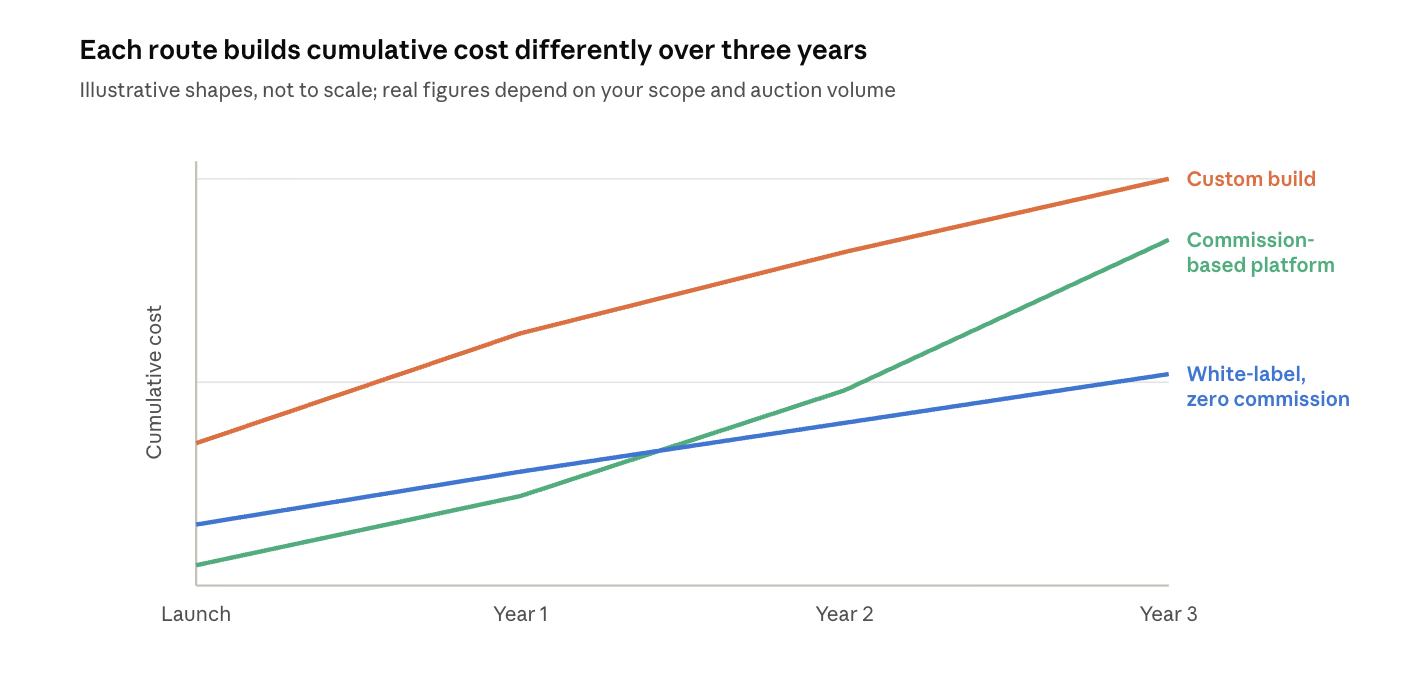
A custom build front-loads cost and keeps a full engineering team on the payroll. A commission-based platform starts cheap, but its cost climbs with every sale. A zero-commission white-label platform keeps cost steady and predictable as auction volume grows.
How to reduce the cost to build an auction website
Lowering the cost to build an auction website doesn't have to mean settling for less. The biggest savings come from decisions made before development starts: what you build yourself, what you launch with, and how your platform is priced as you grow. These six strategies help you invest where it creates value and save everywhere else:
- Start from proven technology. A white-label platform removes the cost of building the auction engine, real-time bidding, and AI from scratch.
- Launch with a focused scope. Start with one or two auction formats and your core categories, then add formats, apps, and regions as demand grows.
- Configure instead of customizing. Use built-in settings for increments, reserves, approvals, and fees, and save custom development for what truly sets you apart.
- Prioritize integrations. Connect the systems you need at launch, such as payments and identity, and schedule the rest for later phases.
- Choose commission-free pricing. A platform that doesn't take a share of your sales keeps costs flat as volume grows.
- Use built-in AI. Starting with AI already in place avoids the need for a separate AI program for data, governance, and maintenance.
Building the ROI case for an auction website
Boards approve platforms based on returns, not just the cost to build an auction website. Frame your business case around the value each auction creates:
- For sellers and asset owners: higher realized prices from wider, more confident competition
- For procurement teams: measurable savings from supplier competition in reverse auctions
- For marketplace operators: fee revenue that grows with every auction, kept in full on a commission-free platform
- For operations: fewer manual hours per auction through automation
- For growth: new markets reached through multi-currency, multi-language bidding
A simple way to present it: estimate annual value created (extra proceeds, savings or fee revenue, plus hours saved), subtract the platform's annual cost, and compare the payback period across routes. AI strengthens the value side directly, because more confident bidders mean more bids per lot and stronger final prices.
Questions to ask for an accurate auction platform quote
A quote's quality depends on the questions behind it. Ask every vendor or development partner:
- Which auction formats and user roles are included, and which are extra?
- Which integrations are standard, and how is custom integration work priced?
- Is AI included, and what exactly can it see and show in each auction format?
- What do hosting, security, and maintenance cost after launch?
- Is there a commission or transaction fee on our sales?
- How is pricing affected if our auction volume doubles?
- What's included in setup, branding, data migration, and training?
- Who owns our data, and can we export it at any time?
How Bidvantic changes the cost equation
Bidvantic is an AI-powered, white-label auction platform. We've already built and tested the most expensive parts of a custom build, and we maintain them for you.
The costly components, ready from day one.
The auction engine, real-time bidding with soft close, forward and reverse auctions, multi-seller auction marketplace capability, roles, approvals, and audit trails are configured rather than coded. Your budget goes into branding, integrations, and the features that set you apart.
AI without an AI program.
Instead of hiring specialists to build, govern, and maintain AI, you start with AI auction software already in place. Auction Intelligence prepares structured lot briefs, Live Bid Advisor guides bidders in real time, and Market Pulse adds comparable auction references. All three follow your role and format visibility rules, which is the governance work that's hardest to build yourself.
A lifecycle cost that stays predictable.
We take zero commission on your sales, so platform cost doesn't rise as your auctions succeed. We scope integrations with your ERP, CRM, payment, and identity systems around your existing technology, and we build in multi-currency, multi-language support.
See Bidvantic pricing for current options, and our guide to auction marketplace revenue models for the value side of your business case.
Final thoughts
So, how much does it cost to build an auction website? The real answer is everything it takes to run well for years: the engine, the integrations, the security, the AI, and the team behind them. Estimate from scope, compare on lifecycle cost, and judge every option by the value each auction creates. On that basis, the right platform pays for itself in stronger prices, deeper savings, and revenue that grows with every auction.
RELATED QUESTIONS
How much does it cost to build an auction website?
It depends on your route, scope, and scale. A custom build depends mainly on team size and build time, and a five-developer team at the US median wage costs about USD 665,400 a year in salaries alone (illustrative). White-label platforms replace most of that build cost with setup and license fees.
What is the most expensive part of an auction website?
Usually the auction engine and its real-time performance, followed by enterprise integrations, security, and AI. These are also the hardest parts to get right in a custom build.
How long does it take to build an auction website?
A custom build often takes many months, depending on scope. Launching on a configurable white-label platform is typically much faster, because the core auction functionality already exists.
Does AI make an auction website more expensive?
Building AI yourself adds high costs for data preparation, governance, testing, and ongoing use. On an AI-powered platform, those capabilities are already built in.
What ongoing costs should we budget for?
Hosting, maintenance, security, new features, participant acquisition, and any commission your platform charges on sales. Choosing a commission-free platform keeps ongoing costs predictable as volume grows.
Is it cheaper to build or buy auction software?
For many organizations, licensing a white-label platform costs less over three years than building, especially when you include maintenance, security, and AI. Building makes sense mainly when auction technology itself is your core product.